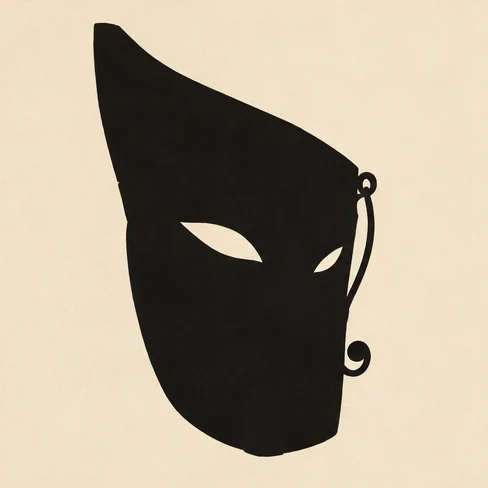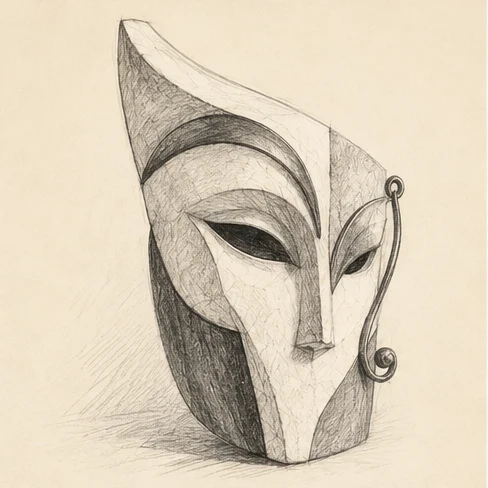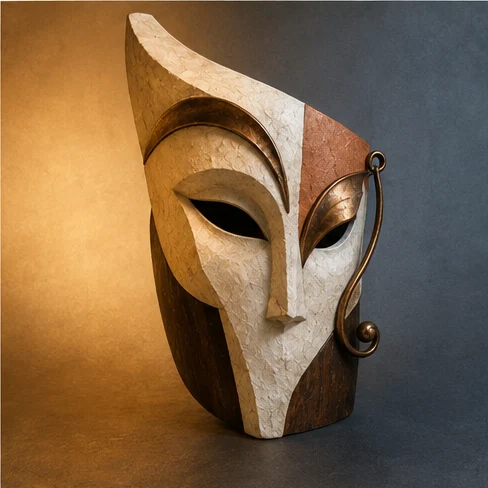
A fire-inspired scene can be suggested through color relationships and the placement of light. Warm amber, a dark surrounding tone and a restrained highlight offer a starting vocabulary. That vocabulary describes a visual design, not a plan to use combustion or hazardous effects on stage.
Choose a dominant note
For our concept, a pale mask provides a quiet field and a narrow bronze-colored curve acts as an accent. The warm-light study shifts that field toward amber. The cooler version makes the difference between the ivory plane and the dark cheek more apparent.
An original palette exercise is to begin with an off-white, a charcoal and one warm accent. Make three small compositions, changing only the area occupied by the accent. Compare whether the face, the border or the background becomes the first thing you notice. The exercise evaluates a drawing, not an audience response.
Treat direction as a design variable
Color alone cannot describe a lighting choice. Direction and distribution determine which planes are revealed and where shadows fall. ETC’s educational resources provide a useful introduction to properties of theatrical light and color.
In a proposed side-lit view of our mask, the raised brow becomes a shadow-making edge. A more frontal arrangement would describe a different set of planes. These are questions to explore with a model and a qualified lighting team, rather than a universal recipe for an actual venue.
Do not confuse a render with a test
The images here are generated illustrations. They do not predict how a specific paint, lamp, camera or human observer will respond. A finish that appears quietly reflective in a concept may catch a much stronger highlight in a physical setup.
For production work, examine a real sample under the intended light and record the conditions. Keep the costume and nearby scenery in the comparison. A color chosen in isolation may have a different relationship to the whole scene once those elements are present.
Let the atmosphere serve the performance
A strong highlight can pull attention away from an eye opening or a gesture. Ask which information the audience needs at that point in the scene. Preserve readable edges and consider viewers for whom subtle color differences are hard to distinguish.
Warmth does not require fast flashing, smoke or an open flame. This study uses simulated steady light and digital texture only. Real lighting equipment, rigging, electrical arrangements and any special effects require the venue’s appropriate professional procedures. The journal supplies a visual brief, not operating instructions.
Sources & scope
These references support the factual context. The exercises and concept-mask interpretations are original editorial proposals, not reports of practical testing.
- ETCEducational resources for lighting
Lighting education covering properties of light and color. Our palette and scene examples are original proposals, not tested settings.
Text prepared with AI assistance. See authorship and human-review status. Source review and last update: 6 September 2026.